

Hiding in Plain Sight: How the "Phoenix Line" Could Transform Atlanta Transit
Imagine a new transit line connecting vibrant Atlanta neighborhoods, major employment hubs, and some of the city’s largest institutions: Emory University, the CDC, Piedmont Hospital, Georgia Tech, and the Mercedes-Benz Stadium. Passengers zip through the “city among the trees” all without sitting in traffic, paying for parking, or sitting in traffic looking to pay for parking. It might sound like a pipe dream, but this infrastructure already exists––and it’s hiding in plain sight.
Meet the Phoenix Line: a proposed transit line that converts existing, underutilized freight railroad tracks into a high-capacity passenger transit corridor.
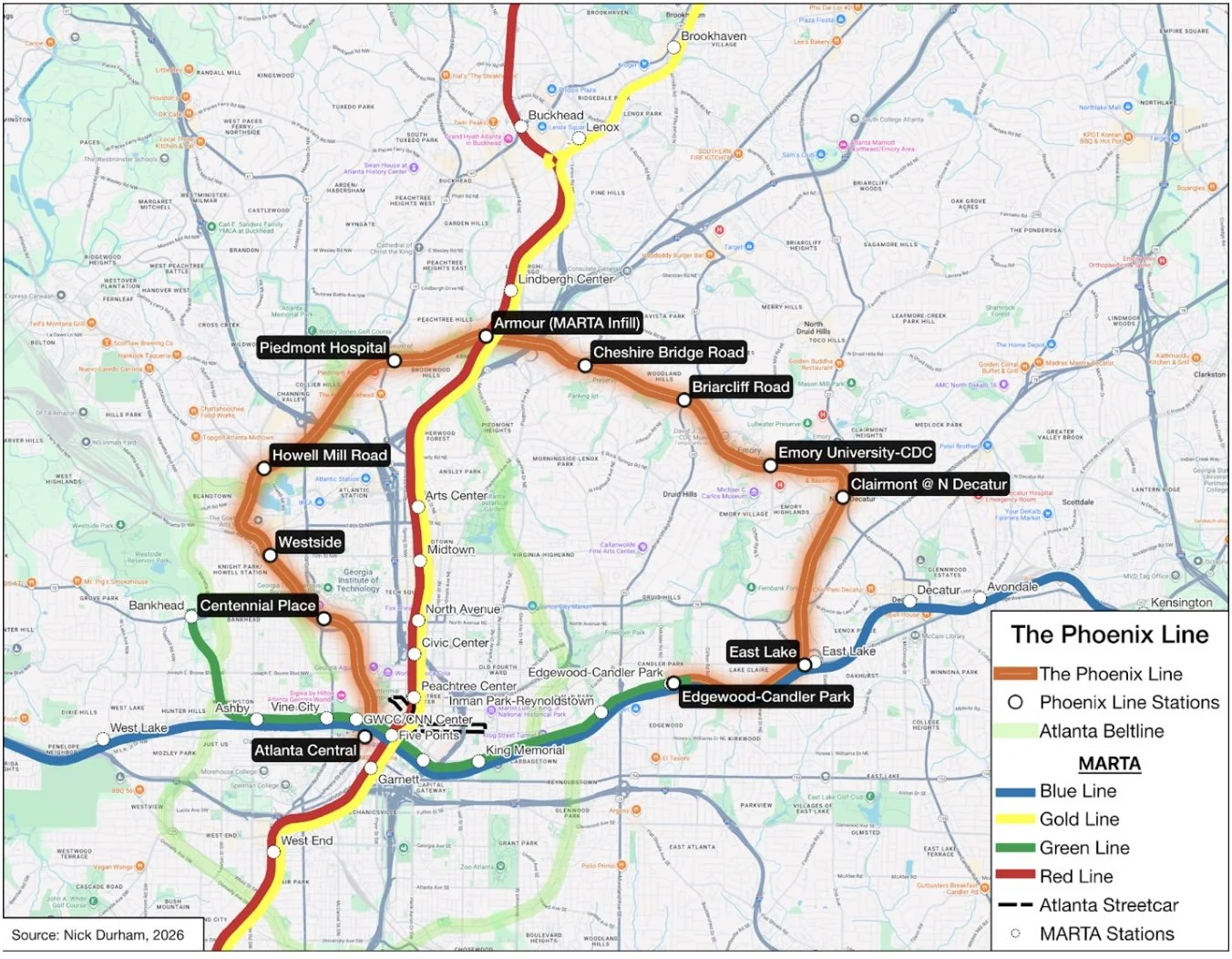
The Phoenix Line
This 12-stop line cresting from Edgewood-Candler Park, up to Peachtree Road and back down through the Westside to downtown would service quickly growing neighborhoods and transform livability, transit access, and economic development across Atlanta, for a competitive price. Whereas investing in new MARTA rail can cost upwards of $250M per mile, retrofitting existing freight paths––some of which carry as few as five trains a day––could reduce that cost by 80%, putting the project on par with the cost of developing Bus Rapid Transit (BRT). Critically, this new system would also improve and expand our aging, yet increasingly vital, freight rail infrastructure.
Because Atlanta and its suburbs were initially built alongside rail lines, unlocking these tracks also creates the backbone for an extensive future regional commuter network. Current infrastructure adaptation plans that prioritize asphalt over people, like the proposed I-285 Top-End “Express Lanes”, will not ease traffic conditions long-term and will continue diluting Atlanta’s greatest asset: its residents. Atlanta does not have to choose between growth and livability. Rather, the key to Atlanta’s metamorphosis in the 21st century isn't adding another lane—it’s adding another train.
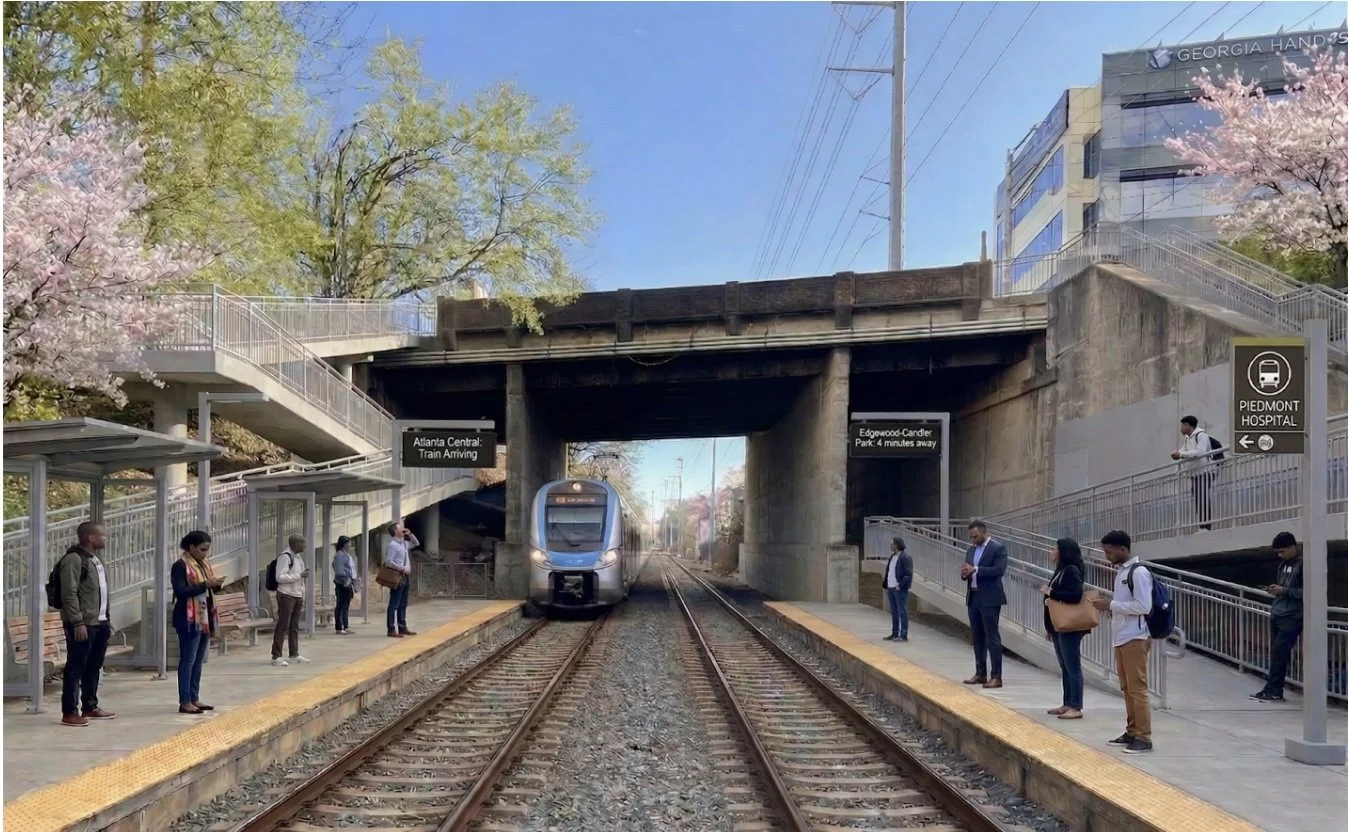
A Phoenix Line station at Piedmont Hospital, intersecting Peachtree Road
The Cost of Doing Business As Usual
Freight-to-passenger rail conversions like the Phoenix Line offer a cost-effective solution to the region’s most persistent, dangerous challenges. The “cars-at-all-costs” approach to urban development carries a truly staggering price tag: $10 billion annually in economic costs due to vehicle crashes in Georgia (according to the DOT); a nearly 20% increase in rent costs due to (de jure or de facto) parking mandates; and significant lost tax revenue because 25% of downtown Atlanta is consumed by parking. The human cost is even higher. Between 2020 and 2024, there were over 394,000 traffic-related injuries in the 11-county metro area, devastating families both physically and economically. In 2024, traffic fatalities in Atlanta outpaced homicides.
As the nation’s eighth-largest metro area by population continues to grow, doubling down on cars-at-all-costs yields diminishing returns. It is safer and more economically shrewd to invest in modes of transit that can move up to 25,000 people per hour safely, rather than 2,500 people per hour, very riskily. Indeed, the antidote to an inefficient, dangerous mode of development and the pathway to a safer, freer city lies in re-booting our origin story as a railroad “Terminus”.
Why Rail Transit?
As any fan of the Beltline will tell you, Atlanta’s history as a rail hub presents compelling opportunities to re-imagine the city. While many cities have been focusing on Bus Rapid Transit (BRT) in recent years to save costs—including MARTA’s own upcoming Rapid A-line—rail conversions like the Phoenix Line offer the best of both worlds: the lower price tag of BRT with the higher capacity, speed, and ridership of rail transit. Crucially, rail stations drive economic development and help properties retain value in ways even the best BRT stations rarely do. One study by the National Association of Realtors and the American Public Transportation Association (APTA) found that residential property values within half a mile of rail transit held their value 41.6% better than those without it following the 2008 recession. More broadly, every dollar invested in public transit provides a long-term impact of five dollars in impacted communities. Charlotte’s Lynx Blue Line light rail, for example, has attracted $2.8 billion in private development. The increase in transit access and walkability generated by the Phoenix Line would not only generate significant private investment, it would transform economic opportunity and the freedom of mobility within Atlanta and across the region.
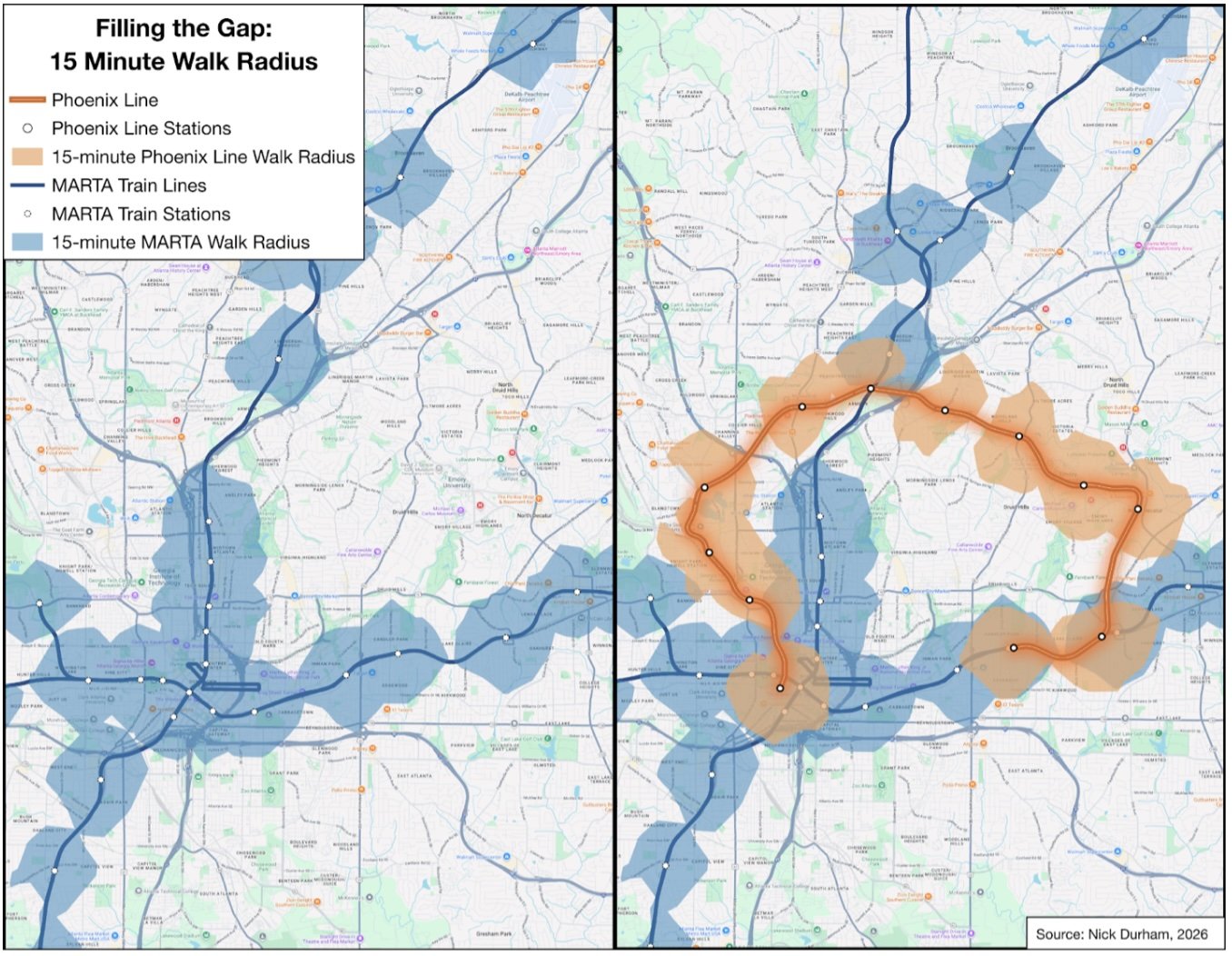
The Phoenix Line would fill a critical gap for bringing more communities within walking distance of a rail transit station in quickly growing Atlanta neighborhoods.
This freight-to-passenger conversion strategy scales excellently across the metro area. Currently, only 15% of the metro area lives within a 15-minute drive of a train station. Retrofitting the region’s underutilized freight corridors could skyrocket that number to a whopping 85% and would catapult metro Atlanta’s transit system to be potentially the fourth-busiest in the nation behind only New York, New Jersey, and Chicago. With this system, 83% of the region’s population would be within a 5-mile radius of a passenger train station and over half of the region’s jobs would be within a one-mile radius of a station.
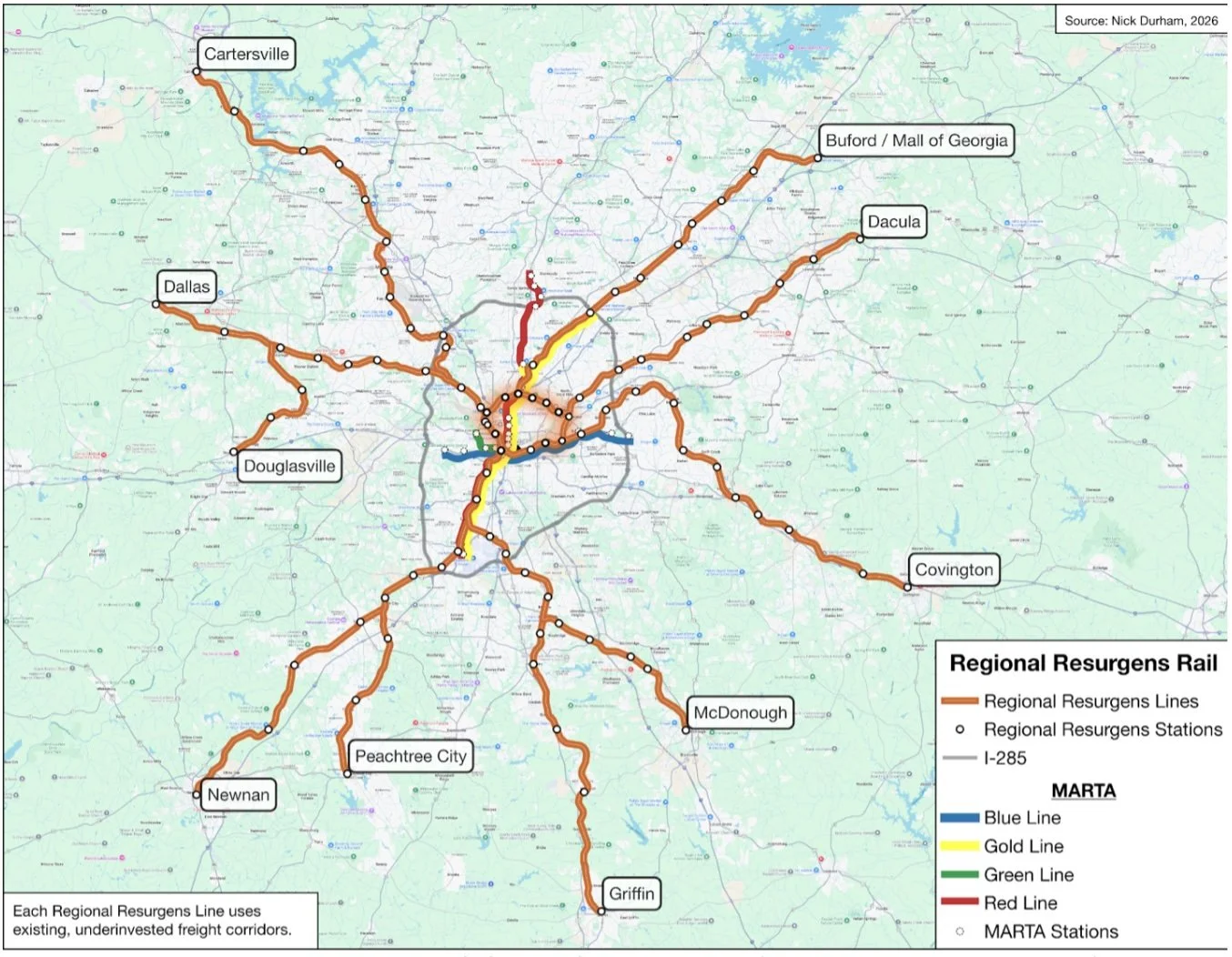
A Resurgens (“Surge”) Network of Expansive Regional Commuter Rail––All Using Existing Infrastructure
Imagine a region where residents in Lawrenceville can easily ride to their job (or flight) at Hartsfield-Jackson, or where residents in Douglasville can take the train all the way to their job at the CDC. As Atlanta suburbs’ sprawling infrastructure continues to grow and age, it will become significantly more expensive and inefficient to maintain. A coherent rail network is the most efficient use of our space and resources––and the infrastructure is already there.
Show Me The Money
Funding transit expansion requires political will and creativity, but the path is proven, even in economically uncertain times. In the early aughts, the metro Denver area passed the “FasTracks” initiative: a .04% regional sales tax. 16 years later, despite a major recession, eight train lines were operational. According to the Denver RTD website, 15,000 full-time jobs were directly created as a result of the FasTracks since 2005.
Economic uncertainty and fluctuating federal support can even be a catalyst for re-thinking funding models. We can look to history: early U.S. streetcars were often supported by real estate companies who banked on the tracks increasing the value of their adjacent land. In Hong Kong, such property-based revenue schemes now help public transit fund itselfwithout government subsidies––a compelling strategy not too dissimilar from the Tax Allocation District (TAD) mechanism already providing 75% of the Beltline’s budget.
The Phoenix Line’s proposed route would service neighborhoods whose density already justify improved transit access, while offering abundant opportunity for additional transit-oriented development. The Twin Cities Metropolitan Council's Transportation Policy Plan outlines minimal viable activity around a transit station to be 7,000 total residents, jobs, or students. As seen below, using 2023 ACS and LODES data, a proposed Emory-CDC station would service 47,629 jobs and residents. A new Piedmont Hospital station totals over 22,000, and a new Westside station over 18,000 activity units. These three stations would serve new neighborhoods not covered by MARTA rail. Stations like Armour would also align with proposed MARTA infill stations and would provide critical connections to the Beltline. This proposed network more than justifies its creation and would empower neighborhoods to grow in a coordinated and efficient manner.
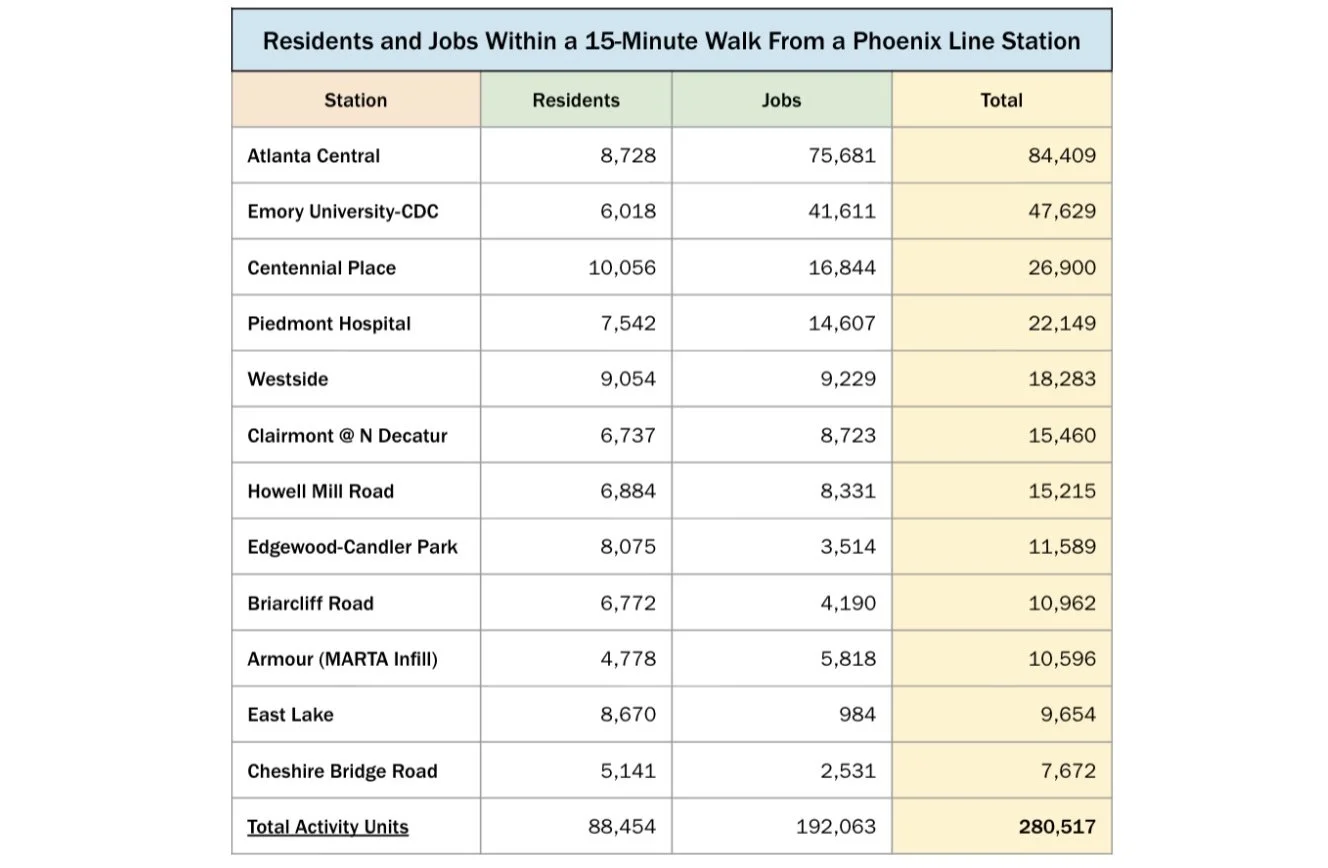
Residents and jobs within a 15-minute walk of a Phoenix Line station
The Phoenix Line’s route also creates immense potential for public-private partnerships. Within a half-mile radius of the proposed line sit massive economic engines: Piedmont Hospital, Emory, Georgia Tech, and more. These institutions would benefit directly from improved accessibility and should be key stakeholders in its development. Additionally, ambitious public leadership could drive Payment-In-Lieu-Of-Taxes (PILOT) contributions from adjacent, wealthy, tax-exempt institutions like Mercedes-Benz Stadium.
Atlanta is home to the eighth-largest concentration of Fortune 500 companies in the U.S. Between the 1996 Olympics and the Beltline, the city has a proven track record of galvanizing private money for public good. Rather than passing around an “offerings bucket” at a Sunday service, public agencies have an obligation to economically leverage and partner with private beneficiaries of the Phoenix Line, including and especially the freight rail operators themselves.
Operationalizing Freight-to-Passenger Conversion
Realizing the Phoenix Line entails improving and right-sizing Atlanta’s balkanized rail infrastructure. Certain lines languish with just five trains a day, while critical connections like Howell Junction are overwhelmed by 66 daily trains. Other corridors remain physically underbuilt with a single track despite having the space for four. Compounding this is a projected 76% surge in regional freight traffic by 2040. Failing to modernize this rail capacity means more freight on highways and worse traffic and safety in a metro area already plagued by three of the top ten worst truck bottlenecks in the country.
Critically, investing in passenger rail like the Phoenix Line and a broader regional Resurgens Rail Network (“Surge”) would simultaneously enhance both freight and passenger volume. Since these lines would share some common infrastructure, strategic partnerships with freight operators to modernize signals, expand trackage, and upgrade infrastructure would help consolidate, re-route, and optimize existing freight traffic flows throughout Atlanta’s expansive rail network. North Carolina’s Piedmont Improvement Program offers a compelling precedent, where a series of rail and highway enhancements between Raleigh and Charlotte helped generate more economic opportunity for business and freight partners while increasing passenger rail service. Using a similar approach, investments in the Phoenix Line would result in a transportation system where both freight and passengers move more frequently, reliably, and rapidly.
Why Now?
Building new transit might feel daunting, but it is far more realistic than expecting more asphalt to inculcate better traffic flow and livability in such a quickly growing city. Atlanta’s rail infrastructure lends the city unusually well to creatively and efficiently develop passenger transit that could save the city from the weight of its own success.
Atlanta’s streetcars, pictured below, ran from the 1870s to 1949—a lifespan of nearly 80 years. Our current experiment with highway-boosted car dominance, beginning in the 1950s, has now lasted roughly the same amount of time. It is time for the next era. A future beyond cars-at-all-costs is freer, healthier, and more vibrant. Atlanta is defined by reinvention, and we deserve world-class transit to match our world-class city. The Phoenix Line is a critical, urgent step toward closing that gap.
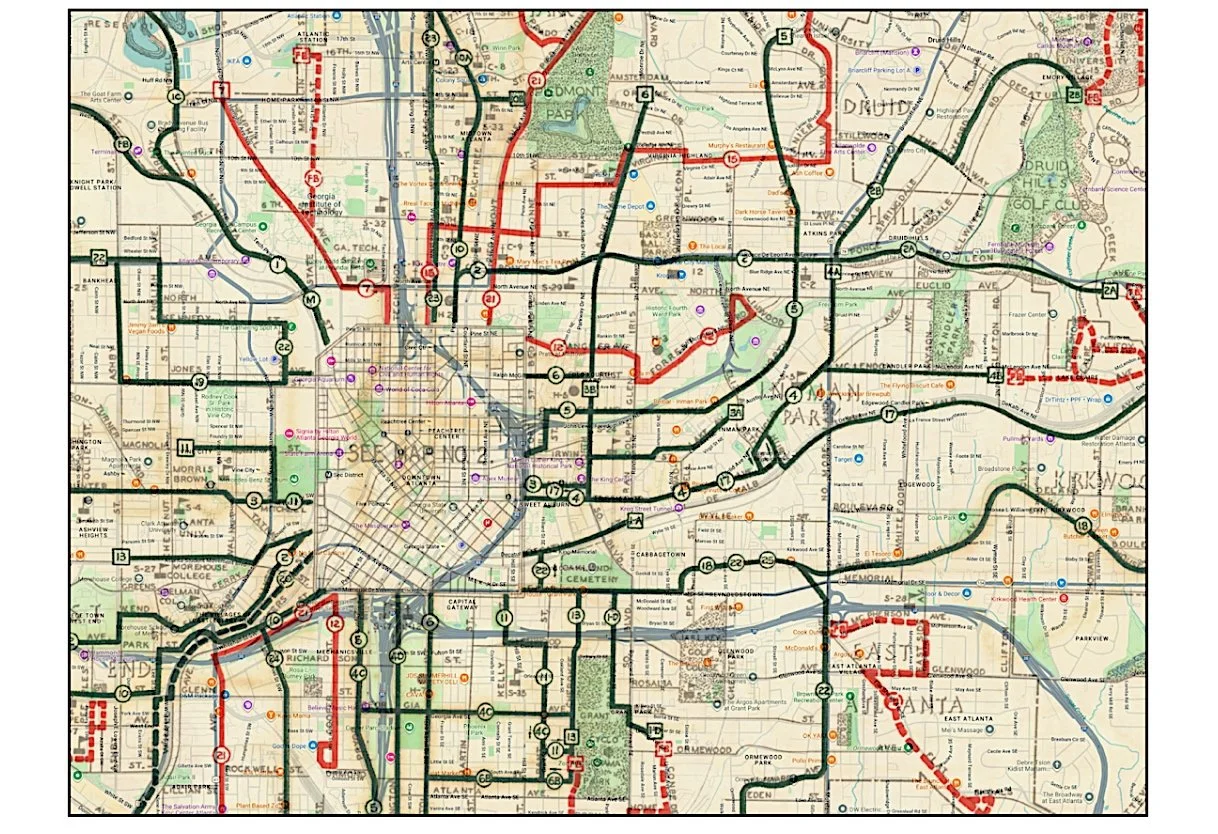
Map of Atlanta streetcar system, circa 1950, overlaid on top of Google Maps.
Additional information can be found online at ResurgensRail.com
As of 2026, Nick Durham is enrolled in a dual MBA–Master of City Planning program at MIT and also works for Invest Atlanta. Nick holds a B.A. in History from Harvard University and has prior experience at public impact-focused startups in the waste re-use and climate technology industries. Most importantly, he was born and raised in Atlanta.