

Kristin Allin, the Regional Housing Planning Coordinator for ARC (Atlanta Regional Commission), chats with us about the future of housing growth in the Atlanta region and how planning can play a role with creating greater access to affordable homes in more walkable places.
We discuss the ARC's new Housing Forward 2035 planning document:
Episode Transcript
Darin Givens:
Welcome to the ThreadATL podcast. I'm Darin Givens. Today I'm talking with Kristin Allin. She's the regional housing planning coordinator for ARC. That's the Atlanta Regional Commission. Thanks for talking with me today, Kristin.
Kristin Allin:
Yeah. Hey, Darin, It's great to be here. Thank you for having me.
Darin:
So we're going to be talking about a new report that has been released by ARC, which is called and am I getting this right? The title is Housing Forward?
Kristin:
Yes, it's Housing Forward 2035. So looking approximately 10 years of action out into the future.
Darin:
And is this a report that you generally generate at ARC regularly or is it new?
Kristin:
This is actually our agency's very first regional housing strategy out of this document.
Darin:
OK, well, let's talk about it. For a lot of people, housing policy can seem like something that only affects us very locally on a neighborhood level, or in the case of city dwellers like me, something that just affects our own city. And I'm including myself in that group because I get stuck inside the bubble of thinking very locally about my city or hyper locally about my neighborhood a lot. So what do we need to understand about the importance of a regional housing strategy, particularly in terms of its ability to address problems that a city can't address alone?
Kristin:
Yeah. So I think for many decades, Metro Atlanta, which for my position is defined as the 11 counties of metro Atlanta, and we've been a relatively affordable place to live. And that's fueled growth and a lot of prosperity in our region. But rising costs have been eroding this advantage that we've had over the last, you know, several decades. And the rising costs are also bringing new challenges that need a regional response. And so the Atlanta Regional Commission, for those listening that haven't heard of regional commissions before, they were actually set up for this purpose.
There are 12 regional commissions in Georgia and they were set up because our urban areas, our large urban areas are extremely complex and interconnected. And so every city and county in Georgia has a regional Commission and recognizes that many of these aspects of planning that we do as a regional Planning Commission cross jurisdictional boundaries. So our agencies are charged with really understanding these challenges and addressing these challenges at the higher level because we understand that challenges may be difficult to solve city by city or county by county and need more of a regional perspective. So just kind of ground that in the work of the regional housing strategy.
We are currently launching this regional housing strategy to better connect housing and transportation because we are, you know, our core, a transportation agency. But connecting those two to understand how we might impact housing and address the negative impacts of lack of affordability, lack of access of our residents and understanding that many of these policy decisions, as you mentioned, are local. But when we step back, we see that local decisions don't happen in a vacuum, and so we have these large, intractable issues. It's often impossible just for cities and counties to solve them alone.
Minimize image
Edit image
Delete image
Darin:
If I remember correctly, ARC actually has programs for or or grants that can go to cities for their planning needs. And I assume that that kind of grant program would be associated with this kind of thinking about housing on a regional level.
Kristin:
Yeah. And so there is a connection that was made in federal law a few years ago between housing and transportation. And the majority of the dollars that ARC has come through federal transportation dollars. And this can be planning like you mentioned. So we have a lot of different planning programs that use those funds and it can also be around infrastructure development. So it's not just the planning part, but it's actually, you know, making that infrastructure happen.
Darin:
OK, So I was able to look at the Housing Forward document. It's a big document. There's a lot in it. And this is something that anybody can find online. It's on the ARC website and you can download it and read it. And one quote that I really liked that really stuck out to me was this. I'm going to read it. “Meeting future housing demand will require encouraging growth in areas where jobs, transit and opportunity are concentrated.”
I read that and it really stuck out because it's just the kind of thing that I've been interested in ever since I started, you know, sort of my amateur study of urbanism, you know, connecting these things together. And I wonder what this kind of connection really means for the physical form of metro Atlanta in terms of creating more walkable neighborhoods and mixed-use development and more density around transit. And how much change are we talking about here?
Kristin:
Yeah, those are all great points. And what it means to this plan and for our goals for the region is more neighborhoods with a diversity of housing, housing at different price points and also housing types. So not just single family homes, but what we call missing middle, also more density, more walkability. And that walkability makes our cities more desirable. And we've seen that, you know, in our cities that have started to densify and to really encourage that walkability and multimodal types of transportation.
And you know, you asked about in your previous question our planning programs and that will highlight our LCI, it's called the Livable Centers Initiative program. ARC has run this program for the past 25 years and we've invested $390 million in both planning grants and transportation dollars to 126 LCI communities. So some of these, you know, you might have heard of. They include Decatur, Avondale, Woodstock, Lawrenceville, Hapeville, Chamblee, and many others. There are 126 of these communities. But the funds have helped many of these cities bolster their downtowns and sidewalks, bike lanes, trails. So we know that the program works, but what hasn't been addressed fully in this program is affordability.
So through the LCI, we've added density to these areas. But many of the residents, we did a report on this program last year, a 25 year report to see all of the different demographics and the changes in these areas. And we've seen that primarily renters really struggle to afford housing in these areas. We are not, you know, really adequately addressing this.
And that affordability problem is showing up in other ways in the agency's data and surveying as well. We have a survey called the Metro Atlanta Speaks survey. And last year was the first year that our residents across the 11 counties ranked housing as the number one challenge above traffic and crime. So I mean, as an agency through the LCI program and our other grant programs, we know how to target our funds to better planning outcomes. And so now we're re-evaluating when it comes to housing access and connection, how we can better target the funds and the planning work that we do. So kind of back to that question, what is your initial question?
What does this mean? We have three goals in the plan. So home production keeps up with our region's growth, but also addresses our affordability gap. So as we grow, addressing that affordability gap, also reinvestment of housing, your transit and jobs, activating vacant and underutilized land and targeting funds to jurisdictions who are committed to help address these challenges and realize these goals. So change, we understand that change is needed and ARC is here as a planning agency across the 11 counties to really help support our local communities and how they get there.
Darin:
Well, it sounds great. I mean, it's like I said, it's the kind of issue that I have been interested in for years as an amateur urbanist, you know, following along. One of the things that sort of got me into this was, you know, just moving from the suburbs where I grew up in Cobb County to the city and realizing how difficult it was to walk around and live without a car in the city when I thought it was going to be much easier. I mean, it is definitely easier than in the suburbs, but it wasn't as easy as I thought it was going to be.
And, you know, just sort of doing that amateur study and, you know, finding out what planning is about and how it affects how easy it is or hard it is to get around without a car or how easy or hard it is to afford housing near transit. I think that a lot of people like me just wonder about these things and they don't know exactly how to speak up about it to their, you know, local leaders. And I think that what we're talking about here, this housing strategy might be something good for people who are just amateur urbanists to learn about, so that they actually know how to talk to their local leaders about it and, and sort of what to ask for, I guess, in terms of changes that might be desired.
Kristin:
Yeah, I mean, you're absolutely right. And I don't know. Well, actually, I do know that most people don't fully tie into the planning process. And it's so important to what you're talking about to accessibility, to sidewalks, to bike lanes, to trails, to housing, to economic development. There's planning kind of basically happening all the time. So we've got a lot of different regional plans that are ongoing that we're always out in the public asking for support on.
But locally, we have what's called the comprehensive plan, and those are updated every five years. That's required by the state. That's a really great way to tie into planning in your own community. And most of our communities also have strategic plans. So the comprehensive plan and the strategic plan are a really great way to tie in at the local level, whereas things like the regional housing strategy and some of ARC’s, other kind of larger plans are a great way to tie in regionally.
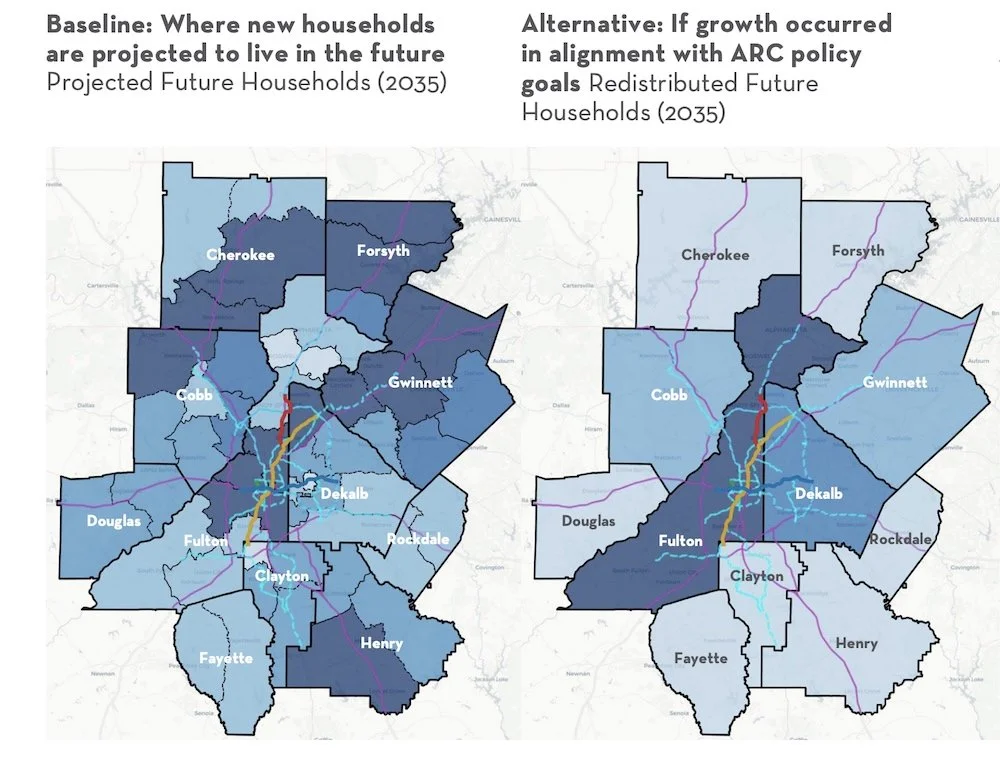
From the Housing Forward PDF: Maps of where new households are projected for the future, with and without ARC policy goals. The map without the goals shows growth of suburban sprawl.
Darin:
So I want to ask about zoning now. And zoning is something that I am still learning about. And I've, I've been reading about these things for 15 years or over 15 years now. I still don't entirely understand the zoning, but I'm going to ask a question as though I understand more about it than I do. So a lot of Atlanta area urbanists are interested in zoning reform, things that would allow missing middle housing and walkable development, and transit oriented development, more so than what is allowed within the status quo of zoning. So does ARC see this housing strategy in part at least as a case for cities to change their land rules, land use rules, like change their zonings, for instance? Are there particular local policies that ARC thinks cities should be reconsidering in terms of their zoning?
Kristin:
So when we think about, you know, our goal, our, our, we, our vision is 1 great region. So when we think about what 1 great region means to us or if you were to look at a locality, we want to ensure that the housing is adequate across not just the income spectrum, but the life cycle as well. And those two, you know, are both very important. So when you're thinking about housing across the income spectrum, this is from, you know, your lower incomes that may be workforce, restaurant workers, industry workers, nurses, teachers, up to higher wages and then to retirees. So we want that income spectrum and the life spectrum to be full and realized across every community so that every city and county really has a role to play in kind of realizing that goal within their own community.
And we recognize that if we're working to meet the goal of this kind of housing across income and life cycle spectrums, as we are also looking to shrink that affordability gap that I mentioned, that we're also looking at incomes below the $55,000 mark. That wouldn't be possible without leaning into smaller housing types.
And those housing types often referred to as the missing middle, are those homes that fall between a larger single family home and your kind of bigger apartment building. So everything that falls kind of in between those two. And we recognize that those used to be abundant in the metro area and many still exist. So you can see, you know, see instances of them in many of our existing communities. But we can also increase that because a lot of these are now illegal to build. So we have room for missing middle, we have room for infill housing in our city centers. And we also can increase our focus on housing at transit stations, at MARTA areas, at bus routes.
So to do this, our regional housing strategies scored areas of the region by 4 policy priorities. So that included, you know, are these areas close to jobs and transit? Would we be moving people that are of a lower income so that they are able to live in areas of higher opportunity? And we also took into account not negatively impacting climate consideration.
We want housing and climate, you know, climate, tree canopy and all that to work together. So as part of this, we scored those parcels for how they meet those criteria. And then we also incorporated some of that into a vacant and underutilized parcel map. So to help us understand the where, you know, so we know what that we want, but then the where. So we can help determine as an agency how we direct that funding, that transportation funding I talked about and how to assist local governments as they help address the housing challenges in their community. Yeah, and it's actually a really interesting time to be doing this too.
I don't know if your listeners or if you've heard about the federal Road to Housing bills that we are working, you know, regionally on this plan. But at the same time, there's been a federal bill that was passed called the Road to Housing. And a lot of that funding, if it, if that bill is funded over the next several years, a lot of that will it kind of mirrors some of the goals that we have in our plan so that cities are more able to accommodate different housing types, that they're more innovative, that they're targeting these areas around transit and jobs. So a lot of these are really aligned together. And we would love to see that funding come through in the future and be able to have our strategy at the regional level work locally and with the federal efforts.
Darin:
That's great. On a personal level our son who is in college now, doesn't have a driver's license. He grew up in the middle of the city with us riding MARTA and walking everywhere. Yeah, I do worry about him. You know, if he continues to not have a driver's license and try to get around without MARTA, is he going to be able to afford, you know, as as a young person with a young person's income, is he going to be able to afford to live in a really walkable transit served place, You know, like I've had the privilege to do? And I wonder about not just my son, but a whole new generation.
Kristin:
And a lot of the people in that age bracket do fall in that 55,000 or below level, which the report, you know, talks about how we target that level because that population is the least likely to be served by new housing production. So the report indicates that between now and 2035, only 25% of households that earn incomes of 55,000 or below will actually be served. They will not have the housing they need. So only 25% will actually have the housing they need and 75% will not. So that's a direction that this strategy is looking to to implement or to impact with the work that we're doing.
Darin:
So you mentioned 2035, that's the year on the plan.
What are some concrete things that you hope people will see happening in cities across the region that would not have happened without the Housing Forward plan in 2035? You know, just looking ahead towards that year?
Kristin:
Yeah. And you know we have a set of actions in the plan that are all really centered around ARC leading and quarterbacking this, but it really is a collaboration and partnership. And so we have, we recognize that there are a lot of exciting things happening in housing and things that are adjacent to housing, trails, funding, parks, green spaces. And part of this plan, part of the plan is really how we take the actions that are going well and make a positive impact and spread that knowledge around.
So part of it is understanding what is actually going right in our different communities and spreading that knowledge. And we're no longer just recognizing that the partnerships are really important because we're not only hearing about housing from our advocacy organizations. We also formed the goals of this strategy and the actions that we are and you know, imparting on between now and 2035 with employers, with healthcare organizations, with funding organizations, nonprofits, philanthropy, community members and our local governments who all really want to find a better way forward.
So we're seeing housing impact across not just our 11 counties, but across all of these different sectors as well. And I think we feel the impacts of the lack of action and we see it in an increase in homelessness and also that hidden homelessness and also in economic immobility. So I don't know if you've heard the statistics on economic mobility in the metro Atlanta area, but we are actually now ranked last in our country. So we are 50 of 50 in the United States for economic mobility.
That means that a child that's born into poverty in the metro Atlanta area is the least likely of any other place in the country to come out of poverty by the time they reach adulthood. So that is also a new kind of adjacent initiative for ARC called Opportunity Rising. And housing is definitely integral to that economic mobility. You know, so we feel, I think we're feeling this lack, you know, lack of housing choice day-to-day. Our older people, I think, are feeling it kind of being locked into their house and like you mentioned, younger people.
I think you asked when we will know this plan is working. And so I think we will know it's working when we have built this big and broad coalition that's working together on these issues. And that means that the City Council members, the electeds, the planners, the neighborhood advocates, developers, they shouldn't just look to see what might change with this plan. They should actually plug into this regionally. They can do that several ways. They can join ARC’s leadership programs. They can participate in our planning work and implement the regional housing strategy.
We're setting these ambitious goals in the plan. We will be tracking our housing progress. We'll be engaging employers, developing housing communications and also a regional homelessness initiative. So we're hoping that we, you know, people will see this progress over the years in the things that we've talked about: housing, transit, housing near jobs, new housing, diverse housing types, housing at different income spectrums. And subsidized housing in areas of opportunity. We hope that people will see that, but we also hope they won't just wait and see it, that they'll actually plug into that work as well.
Darin:
Right. Yeah. So, so those different parties will have to be sort of proactive in, in joining in with the the things that are in the strategy and partnering with ARC on making these happens because these things happen because there's there's no like mandate, there's there's no like, you know, governance structure on the regional level that would demand that cities partner and in with this strategy.
Kristin:
That's correct. And every city is unique. You know, we have 11 counties and over 75 different cities in our jurisdictions and every one of them are unique. So the first step that we usually take is a housing strategy and identifying, like I said, those vacant and underutilized parcels and then bringing in partnerships. So it's a process and we don't have any way to mandate that for our cities, but we have a lot of funding and kind of incentives to, you know, kind of bring cities along with us.
We're also talking about launching as one of our actions, launching a housing certification program so a city or a county can become certified as, you know, housing ready or housing friendly or whatever that term comes up with. So how do we as the regional Commission not only encourage and incentivize through our scoring mechanisms that participation, but you know, also support through that? So with example ordinances, best practices, what's going right in other areas. So we really want to move this forward through encouragement and support as well as our funding capabilities that we have.
Darin:
Awesome. Well, I personally encourage people across the region and in cities across the region to get on board with this strategy because I mean, it really does seem to be addressing some very important things and some very positive changes for the region with its housing and more. I mean, because housing and transportation and the economy are all, all linked in such an integral way.
Kristin:
Yeah, they are. And we're, you know, actively working on how we connected this strategy with our economic development work that's coming up with the economic mobility, so workforce development and our aging department. So there is a lot of connectivity to be made between housing and all of these different issues that we address regionally here.
Darin:
Awesome. Thanks so much for speaking with me today, Kristin, and thanks for the work that you do. I think it's really important and I enjoyed our chat.
Kristin:
Thank you. Great to be here.
